[Worldbuilding note] What If Magic Existed at the Dawn of Humanity? Why the First Magic Was Fire
If magic had been part of being human from the very start, what would the world look like? Chapter one of my fantasy world: why the first magic was fire.
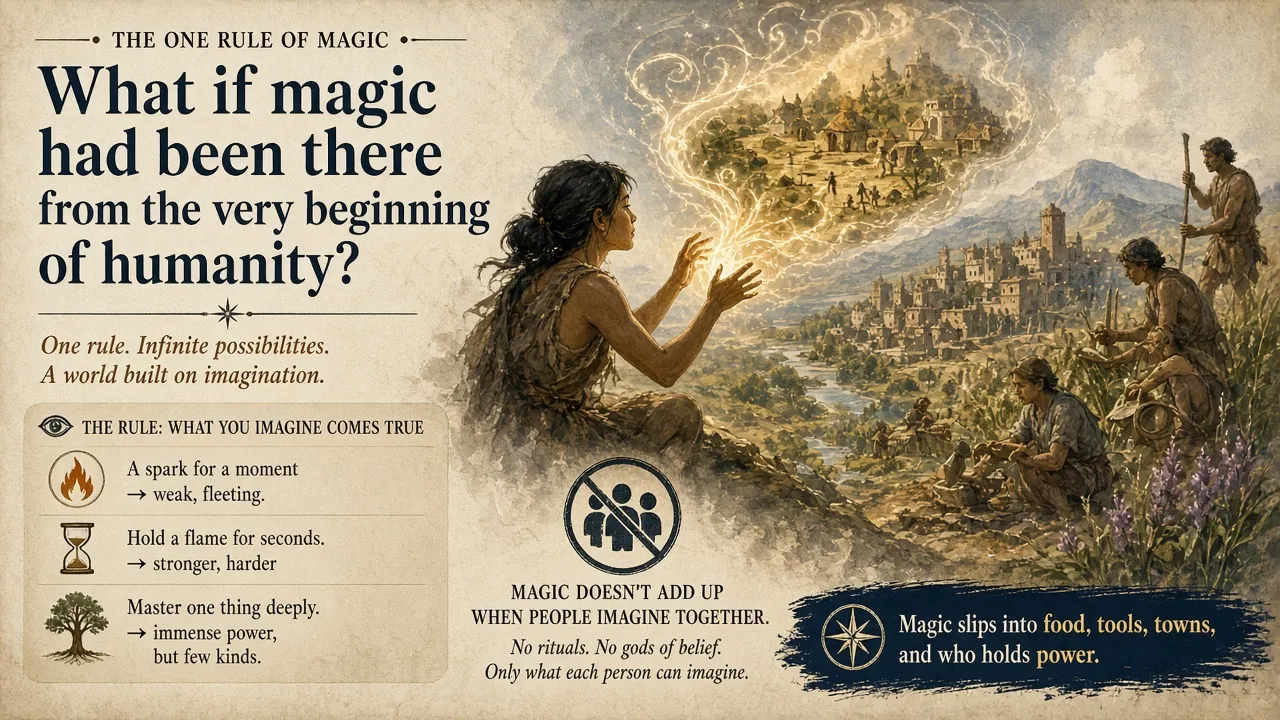
If you love fantasy manga and anime, you’ve probably wondered about this at some point: if magic like this really existed, shouldn’t the world have turned out differently? Once that question gets into your head, it drags another one in behind it, and then another, until you find yourself building a whole world of your own. I’m one of those people. So I thought it might be fun to build the fantasy world I’ve been picturing, a little at a time. This post is the first chapter of a long story I’ll keep adding to every day.
When you think about a world, you can’t help thinking about how humanity began. And the first magic was probably fire.
Not that there was no magic before it. In this world, magic follows one rule: what you imagine comes true. It was there from the very first humans. They just didn’t notice it.
And why would they? Hunters and gatherers rarely have anything left over at the end of the day, and people busy staying alive don’t stop to wonder about strange powers. So magic stayed small, and close to the body. A gust of wind behind a thrown spear. Eyes that spotted ripe fruit a moment before anyone else’s. Nobody called it magic. It was just a good arm, or a sharp eye.
It stayed that small for a reason: you can’t imagine what you’ve never done. A hunter could picture a spear flying a little farther, because they had thrown one a thousand times. Fire was another matter. Lightning split trees and wildfires swept across the plains, but fire was something that happened to people, never something they did.
The day people made fire
Then, while shaping stone into tools, people noticed sparks. Sooner or later someone caught one in dry grass and blew it into a flame, and a new idea came into the world: fire is something a person can make.
That was when magic started to matter. Among all the people striking stones, a very few found they didn’t need the stones at all.
Their fire looked nothing like the natural kind. It needed no fuel; it burned on an open palm, or in thin air. It didn’t flicker, either. It stood perfectly still even in the wind, and wavered only when the mind of the person who called it did. Its color depended on how hot it came out, and that was different for everyone: a cooler flame burned deep orange, a hotter one yellow, the hottest almost white. And the moment it caught on wood, it began to dance like any other fire, as if imagination had just turned into nature.
Not everyone could hold it for long. Some could make a flame appear for a moment; others could keep it going for five seconds, or ten. But a few seconds is all it takes to light a fire, and that’s what it was for. Magic lit the fire, and the wood kept it going.
One is a miracle, ten are a kind
A few fire-callers still don’t make a word, though. In a band of a few dozen people, someone who could call fire might turn up once in several generations, and become a legend about a child the sky had blessed.
Then tools got better, hunting got steadier, and camps grew into villages. On the floodplains, where grain grew without much work, people started to farm. Once a village held hundreds of people, several fire-callers could be alive at the same time. People compared them, noticed what they had in common, and only then gave the thing a name.
People had been using fire for ages by then, and making it for a long time too. What was new was the name. And because the name grew out of fire, the older magic of strong arms and sharp eyes was left out of it. From the very beginning, magic meant fire.
The child without stones
The people of this world remember one story as the very first. It probably wasn’t, but it was the first one followed by a second, and that’s what turned a miracle into a kind.
It was the winter the rain didn’t stop for three days, in a village by the river. The embers in the hearth went out. The old fire-keeper struck his flint all night, but the wet tinder only smoked.
There was a child who was always at his side, picking up stone chips. The child had watched him raise fire thousands of times and had secretly tried it hundreds of times. Now the child cupped two empty hands, closed their eyes, and pictured the spark they had seen so often, right there in their palms.
A flame stood up. There was no wood under it, and it did not sway in the wind or the rain.
People backed away. Fire that fell from the sky didn’t look like that, and neither did fire that ran through dry grass. Only the old man came closer. He looked at the flame for a long time, and then, they say, he said:
“That is the fire I strike.”
The child’s flame went out ten times for every time it caught on the wood. But once it caught, it began to flicker like any other fire, and that winter the village did not freeze. From then on, the old man taught every child in the village to strike stones. It was seventeen years before a second child without stones appeared.
The old fire-keeper had struck more flint than anyone alive, yet he couldn’t do what the child did. In this world, magic takes two things: the vessel you’re born with, and what you’ve done with your own hands. The old man had more of the second than anyone, but his vessel was small. The child’s was big.
And “fire-keeper,” which once meant whoever tended the village embers, came to mean someone who could call fire. Even much later, when people who could move water or wind came along, everyone kept calling them fire-keepers. The word still remembers where magic began.
Deep and wide
There’s a catch to power, though: the stronger someone’s magic, the fewer kinds of it they can do. Going deep into something means focusing on one thing until you grow delicate at it, and that’s the same as not being able to do many things. Some people can hold a single picture in their mind for a long time, and they’re the ones who keep a flame standing. Others leap from picture to picture and do lots of small things, none of them for long.
In the age of fire, depth was everything. One second got you a spark, five seconds lit dry tinder, and ten seconds got wet wood burning on a rainy day. A village got through the rainy season and the winter on the strength of a handful of ten-second people. So when the first surplus came in, the first people a village fed without sending them out to hunt were the fire-keepers.
The wide ones warmed cold hands, sharpened a hunter’s eyes, eased pain, and called up a breeze to dry the hides. None of it showed, so all they ever heard was “you’ve got a good eye” or “you’ve got warm hands.” People called them the cunning folk. In Korea, when a child has a stomachache, a parent or grandparent rubs it and half-sings, “Mom’s hand is a healing hand” (엄마 손은 약손). In this world, that might be literally true.
Why every mage still begins with fire
To this day, everyone in this world who learns magic starts by lighting a fire, and it’s more than tradition. You can only light a fire without your hands if you’ve lit it a thousand times with them. So the first thing an apprentice is given is a flint, and the flint became the mark of a mage.
Fire also shows, which makes it the easiest way to spot talent. Every winter, the children who turned ten that year try for their first fire at the village hearth. The elders watch two things: how long the flame stands, and how still. “If the flame wavers, so did your mind.”
Someone who can start a fire with no tools and leave no trace is the most useful person in any village, and the most frightening. So the first taboo was born: a fire-keeper never calls fire outside the hearth. The hearth, the one place magic was allowed, became an altar, and the fire-keepers became priests.
The trouble is that the first-fire test only finds the deep ones. However much the cunning folk can do, they never make the list of mages. That’s a spark that will start plenty of fires later.
What comes after fire
Fire was only the beginning. If you can only imagine what you’ve done, then every new thing people learn to do opens a new kind of magic. When villagers dig channels to bring the river to their fields, someone will start moving water without a shovel. Kilns will bring hotter fire, and smelting will bring metal. And one day, when the first sails catch the wind, that gust behind the thrown spear will finally be called magic.
Next chapter: the river.
Worldbuilding note
All episodes 1 so far
The age of fire
- What If Magic Existed at the Dawn of Humanity? Why the First Magic Was Fire you're reading this